If it isn’t readily clear from reading other information on this site, there is NO SUCH THING as a discrete “plug” of breastmilk in a breast. Our breasts are far more complex than a tube of toothpaste or garden hose. In just one inch of your breast tissue, you have innumerable (hundreds) of ducts criss-crossing in all different directions.
People often experience “plugs” when they are weaning (i.e. removing milk less frequently) or a baby is feeding more irregularly (same idea – the milk is being removed less frequently, so the cells get swollen and painful). But this is NORMAL GLAND (area of milk-making cells that are very full/prominent).
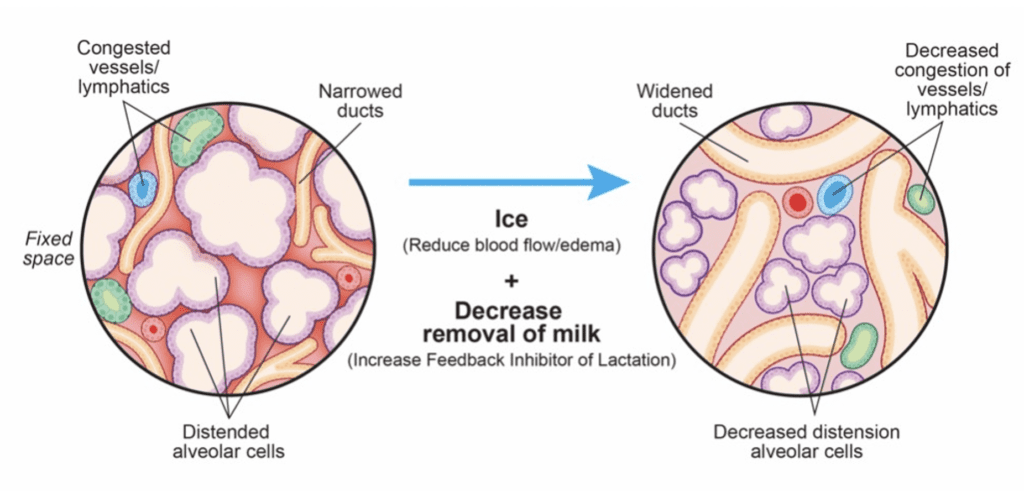
The only time people get into trouble is if they start massaging their breast (i.e. damaging normal tissue and causing bleeding/swelling within the breast). You treat a temporary lump (i.e. normal gland) in your breast with BAIT (Breast rest — i.e. don’t massage, don’t overfeed or over pump, just feed normally or feed less on that side if it is overactive; Advil; Ice; Tylenol).
This is a figure from our Academy of Breastfeeding Medicine protocol that illustrates this principle:
Just remember, the ducts in your breast are like a complicated freeway system of over and underpasses, illustrated by this photo I have in my exam room:

Patients or lactation providers may describe “releasing” a plug with feeding. This is just an example of normal breastmilk being removed with feeding. But it doesn’t mean there was a problem to begin with.
Patients who have blebs (ductal debris, cholesterol plaques, dead cells) represent what is going on inside the breast) may release a bleb (usually through a lot of picking and other nipple damage) and describe “releasing a plug.” Again, it’s just breastmilk that would have down-regulated itself if it wasn’t emptied. And another bleb will follow the initial one, because there’s always more debris along all the walls of the innumerable ducts in that system.