Unfortunately, many patients with BRCA gene mutations may be discouraged to breastfeed, or recommended to breastfeed for a short period of time so they can resume screening. They also may be encouraged to undergo a bilateral mastectomy before they have children. I discuss safe alternatives to this approach in a Breastfeeding Medicine editorial. Two recent studies have also validated the safety of breast conservation in the setting of BRCA, one with a US population and the other in Asia.
Unfortunately, there also was the publication of a very flawed study recently as well. This demonstrated, on the surface, that risk-reducing mastectomy (RRM) in BRCA improved survival. The major flaw is that they did not report screening data from the non-mastectomy group. In other words, if the non-mastectomy group was not getting appropriate breast cancer screening, their mortality would have been increased from this fact alone. The NCCN guidelines for care of BRCA patients provide the safe option of either RRM or high risk screening — but the patients need to be getting screened to make this an equivalent approach!
The study also didn’t acknowledge the potential impact of breastfeeding on improvement in survival. Gene testing was performed at different times — some had it before surgery, and some after. The comparison groups were dissimilar and not matched. So it’s a very, very unfortunate publication to have out there in the world in terms of advocating for breast conservation and breastfeeding.
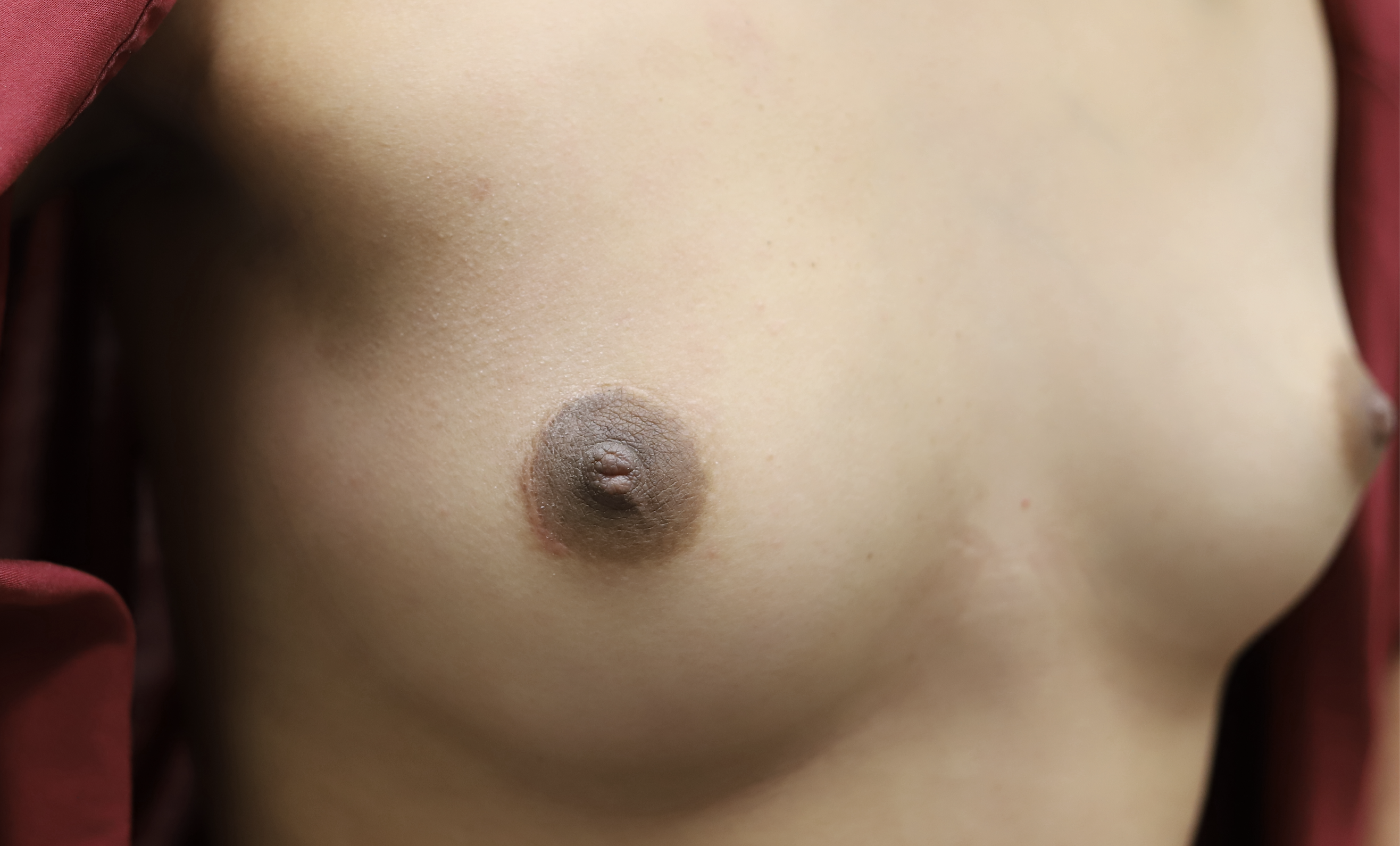 25 year old BRCA2 patient after breast conserving surgery (lumpectomy and radiation) on her right breast, left breast no surgery.
It’s also important to know that patients with BRCA mutations are at high risk for ovarian cancer. However, the good news is that breastfeeding significantly reduces the risk of ovarian cancer development. This impact is particularly significant among patients with BRCA mutations and is another reason to not limit duration of breastfeeding or remove a breast prematurely.
The American Society of Breast Surgeons (ASBrS), American College of Radiology (ACR), and Society of Breast Imaging (SBI) recommend screening mammograms yearly beginning at the age of 40, including during pregnancy and lactation. Mammograms, ultrasounds, and MRI’s are safe during breastfeeding.
In my clinical practice, I counsel patients to get a MRI screen just before pregnancy. MRI is currently contraindicated during pregnancy due to the fact that gadolinium, the IV contrast used for the study, crosses the placenta and may not be safe for the fetus.
They can continue with mammogram and ultrasound during pregnancy. It is best to get the last mammogram and ultrasound just prior to delivery: the breasts will be much less dense before milk production starts, and it saves a postpartum mom from having to go to an imaging center when she is just recovering from birth. She can then get her MRI six months postpartum when the image quality will be better and the initial new mom overwhelm has subsided.