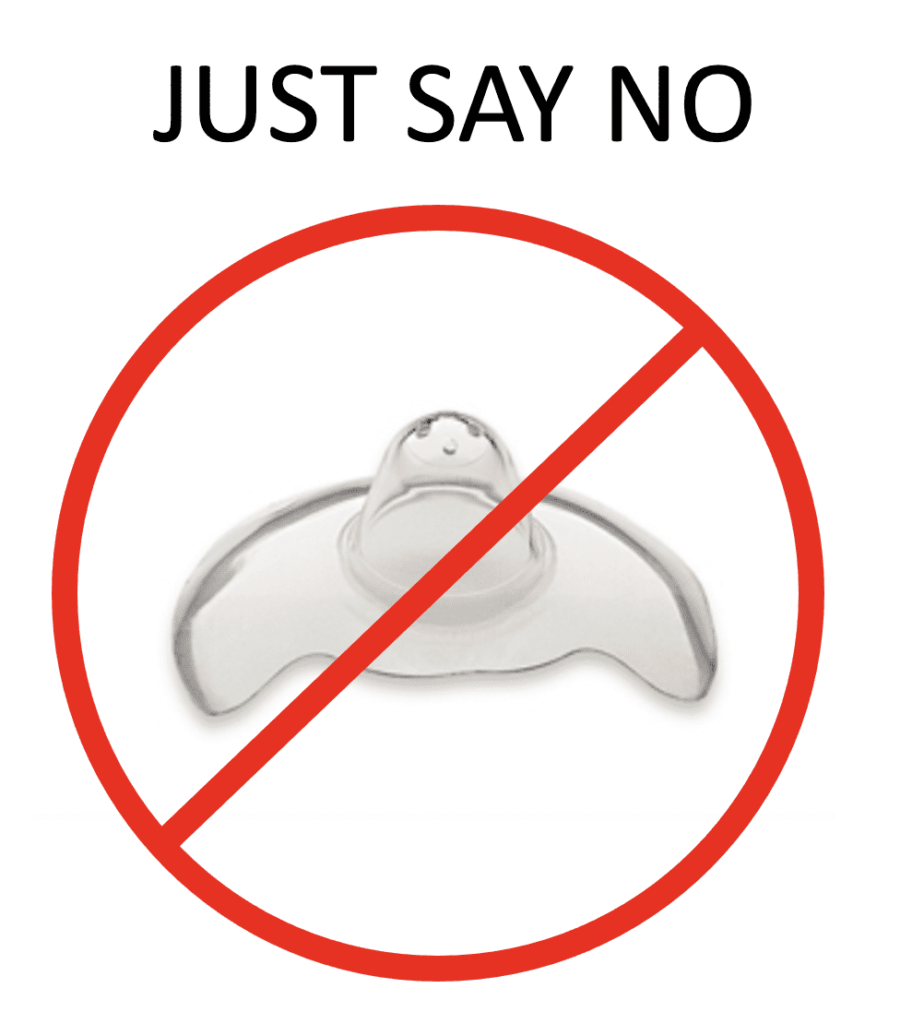
Much of the literature supporting the use of nipple shields has been funded by companies that produce (and earn profit) from them. Anne Eglash explores the dangers of nipple shields in two important Breastfeeding Medicine commentaries.
If you are offered a nipple shield in the hospital, be cautious. Any infant will reflexively suck a firm stimulation of their palate (shields, fingers, bottles).
It is like introducing a pacifier at the breast, despite the fact that moms are often told to avoid other pacifiers and bottles. It is contradictory to have a mom using a syringe to “finger feed” an infant and prevent “nipple confusion” while using a nipple shield at the breast. If you have been sent home from the hospital doing this, stop immediately and give a bottle if needed!
Nipple shields are a marker for other issues that should be explored such as the following:
#1: Larger breasts and the “water balloon effect.” Moms with larger breasts often have nipples that will flatten when mom is in an upright position. The baby cannot possibly latch against the “water balloon” (nor can an adult human!). They clamp and struggle, causing nipple damage. Or they simply refuse to latch and cry or fall asleep.
Large volumes of IV fluid given during labor make this situation worse (your breasts are just as swollen as your legs).
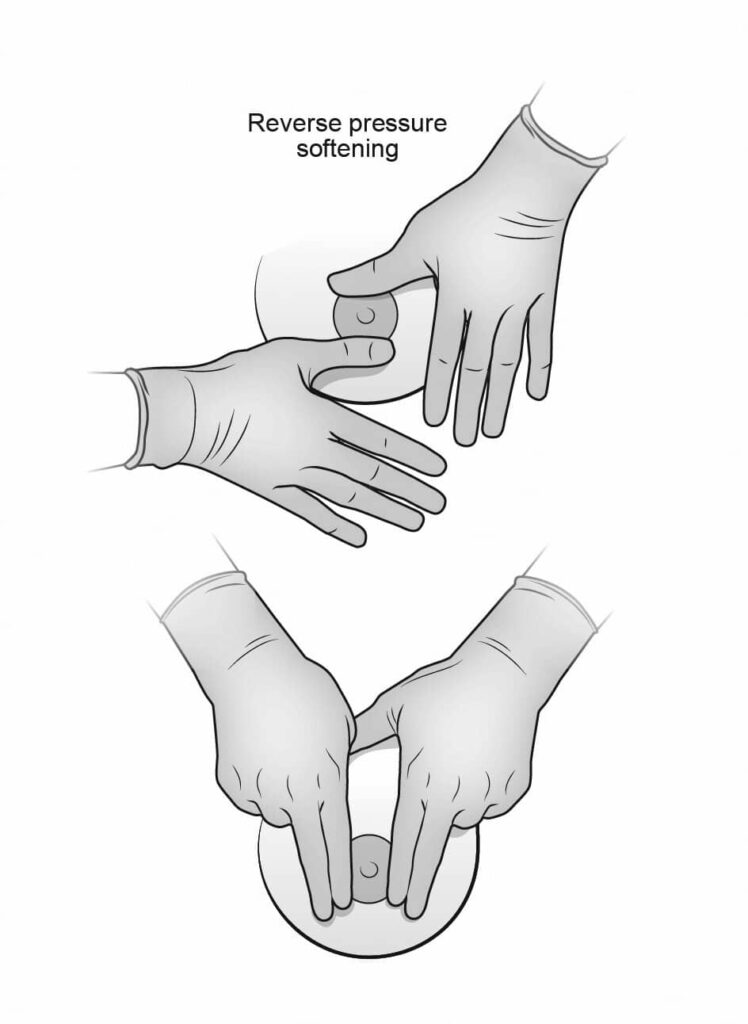
While nipples may be congenitally inverted (related to ductal development and tissue tethering), nipples nevertheless are comprised of erectile tissue and are not “flat.” An untethered nipple can become erect with stimulation. Nipples also can appear much less “flat” if the gravity impact of a large, heavy, engorged breast is removed by the side lying or laid back position. Women can also perform reverse pressure softening to reduce swelling in their nipple and areola.


#2: Nipple shields make a baby to latch to a breast producing too little milk or colostrum: Babies may be sucking, but not swallowing milk.
This makes babies burn calories and negatively impacts milk production. A nipple shield is like a pacifier at the breast. Prolactin (the milk-making hormone) levels can plummet rapidly in the first week of life if mom is using a shield around the clock and not getting any other breast stimulation.
No amount of jaw motion, cheek sucking, “pouching” or other visual cues substitute for the sound of swallowing and a baby that is engaged with nursing then satisfied after a reasonable feed (sucking for 45 minutes or an hour with little swallowing is concerning).
#3: Nipple shields may be offered when a baby is drowning in the “garden hose” effect of mom with engorgement and lots of early milk.
Rather than using a shield, the first step is to feed side lying and help your nipple become erect as above. If oversupply persists, you should be evaluated by a healthcare provider to discuss interventions for hyperlactation.
#4: There are some situations where a mom is so anxious about trying to make breastfeeding “work” that the baby feeds off of this anxiety and immediately becomes fussy when brought to the breast. If the mom feels more confident with a shield and this means the baby will actually latch and relax, a mom just needs to be aware that the nipple shield is an EMOTIONAL crutch, NOT a physical crutch. These are moms with normal nipple/breast anatomy and babies with normal oral anatomy who take bottles, pacifiers, and fingers easily.
In these situations, it’s important to prioritize mom’s mental health and help her understand shield time is no breast stimulation time and potential calorie burn time for baby. As long as she is aware (the real danger of shields is people thinking that babies are actually getting lots of milk), everyone can land in a place that feels best individually.
#5 PAIN. Shields are often started because of significant nipple pain. If you have wounds, then it is important to use appropriate wound care to facilitate healing. If you simply have excruciating pain with latch, that can be treated with medication to stop the pain.
“Getting off” a nipple shield that has been initiated in the hospital can take time, even up to several weeks.

Until you can get help after hospital discharge, these are some important points for making sure mom’s milk is stimulated and baby isn’t losing too much weight from the shield:
- Stop syringe feeding. It is exhausting and demoralizing. Babies also can develop a flow preference with syringe feeding when someone is pushing the milk quickly.
- Hand express or pump your breasts every 2-3 hours if your baby isn’t latching without the shield. Your breasts are not receiving the signal to produce milk when using a shield, so you have to stimulate it separately.
- Start with the shield on the nipple and remove after baby has been sucking rhythmically for 30 seconds. See if the baby may just continue sucking at the nipple. If this doesn’t work, put the shield back on and repeat as needed. Another option is to not use the shield at all, and switch back and forth between bottle at the breast and nipple (make the bottle unappetizing by slowing flow, not letting baby get a great grip on it by feeding it sideways, etc). Understand that this can be a lot for mom and/or baby, so only do this during the daytime and pump milk to give an efficient bottle at night.
- It is much easier said than done, but it is extremely important to be as relaxed as possible when trying to latch baby. A baby will instantly sense mom’s stress and will stiffen and cry. The baby doesn’t have to be in the “picture perfect” position to latch (in fact, this works against you as everyone is focused on trying to remember innumerable “steps” that no one can actually be present).
- So how to get that latch? Just get the baby’s mouth near the nipple and stimulate the nipple to be firm/erect to offer some of the palate stimulation of a nipple shield. Keep a burp rag nearby to wipe saliva/milk off of the nipple so the baby has some traction to latch. Side lying is often the best position to try this as mom and baby can relax lying down, baby has room to kick around if needed, it’s easiest to make a nipple erect, and baby doesn’t have to fight the gravity of mom’s breast to latch. And finally, the baby does NOT need a breast “sandwich.” This technique flattens the nipple and makes the breast a slippery balloon (would it be easier to get your lips on a full balloon or a much less full ballon?)
- Overall, feeds and pumping should be a short, efficient process (not hours). Give the baby an ounce of supplement to take the edge off their hunger and give them some energy to try suckling the nipple. Try latching without the shield. Do some of the switching as described above. If baby or mom becomes too upset, stop. Pump for 10-15 minutes. Feed baby bottle. End. The main issue (this can’t be repeated enough) is that a mom and baby will become quickly exhausted by hour-long feeds with the shield only.
- Understand that all of this is not usually a “light switch.” Any amount of sucking, even for a second or two, on a nipple without a shield is great progress. You may have one good feed without a shield and three where the baby just didn’t take it. You may have two great days and one bad day. Like parenting in general, it’s a process and all you can do is try your best.